 Skip to content
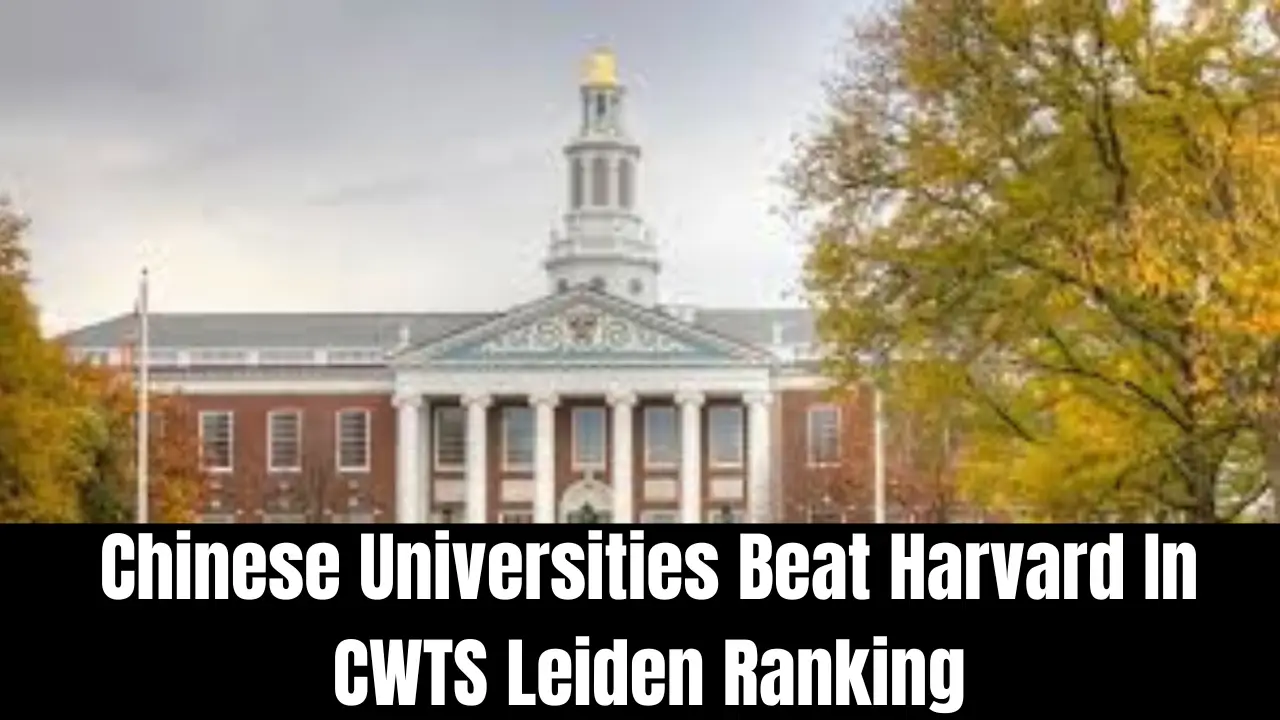
The CWTS Leiden Ranking 2025 has brought a major change in the global higher education landscape. For the first time in many years, Harvard University is no longer at the top. Instead, Chinese universities now lead the Science category. This shift shows how fast research and innovation are growing in China and how competition among top universities worldwide is becoming stronger.

Chinese Universities Take The Lead
In the latest results, Zhejiang University secured the first position, while Shanghai Jiao Tong University claimed second place. Harvard University, which had dominated the ranking for many years, slipped to third. What is even more notable is that Chinese institutions now fill most of the top nine positions, showing their strong performance in scientific research and publications.
Top Three Universities in the Science Category
| Rank | University Name | Country |
|---|---|---|
| 1 | Zhejiang University | China |
| 2 | Shanghai Jiao Tong University | China |
| 3 | Harvard University | USA |
What Is The CWTS Leiden Ranking?
The CWTS Leiden Ranking is an online system that measures the scientific performance of more than 1,500 major universities around the world. It focuses mainly on research output, impact, and collaboration. The ranking is developed by the Centre for Science and Technology Studies at Leiden University in the Netherlands. It uses reliable academic data to compare how universities perform in research and innovation.
How Rankings Looked In The Past
When the first Leiden rankings were released for the 2006–2009 period, universities from the United States dominated the list. Harvard University was ranked first, followed by the University of Toronto in second place and the University of Michigan in third. At that time, most of the top ten universities were American, showing the strong global influence of U.S. higher education in research.
Decline Of Some U.S. Universities
Over time, the ranking pattern has changed. Six major U.S. universities that were once in the top ten are no longer even in the top fifteen. These include the University of Michigan, the University of California–Los Angeles, Johns Hopkins University, the University of Washington–Seattle, the University of Pennsylvania, and Stanford University. This shows how global research leadership is shifting from traditional leaders to emerging academic powers.
Harvard’s Changing Position Over Time
Harvard University was first overtaken by China’s Zhejiang University during the 2019–2022 ranking period. In the next 2020–2023 edition, Harvard again slipped to third place. Still, it is important to note that Harvard held the top position for more than a decade and remained number one until the 2018–2021 period. This long dominance highlights how strong Harvard’s research legacy has been.
Why This Shift Matters
The current ranking results clearly show how China has invested heavily in research, innovation, and higher education. Universities in China now produce large volumes of high-quality scientific work and collaborate widely across the world. At the same time, the decline of some long-standing U.S. leaders reflects growing competition and changing global priorities in education and research.
Conclusion
The CWTS Leiden Ranking 2025 marks a turning point in global university rankings. With Zhejiang University and Shanghai Jiao Tong University leading the Science category, Chinese institutions have clearly moved ahead. Harvard’s drop to third place does not reduce its importance, but it does show that global academic leadership is no longer limited to one country. The future of higher education now looks more competitive, diverse, and truly international.